HD Tile
Visualization
AIFS program
@
$n=HD Tile
$dim=2
r=[0,1,1,0]
h1=-1*[-1,0]
h2=-1*[-2,-1]
h3=-1*[0,1]
h4=[-1,-1]
h5=[1,1]
h6=[-1,1]
h7=r*[0,-1]
h8=r*[1,0]
A=3^-1*(1|h1|h2|h3|h4|h5|h6|h7|h8)*A
Overview
The HD Tile is a self-similar plane tile generated by 9 affine maps, all with contraction ratio but with different linear parts — some are pure contractions, some include rotation, some an axis-swap reflection. Its Hausdorff dimension is , so the tile has positive Lebesgue measure; as we verify below, it also tiles the plane under a crystallographic group.
The mix of orientations — central symmetry () and axis-swap reflection () — makes the IFS look as if its images overlap. In fact, the Open Set Condition holds exactly: the neighbor graph has only 13 pairwise boundary components.
What makes the HD Tile exceptional is the combination of a tiny neighbor graph — only 13 pairwise boundary pieces — and a boundary dimension ≈ 1.993, the positive root of
For comparison, the Lévy C curve — widely regarded as one of the roughest self-similar boundaries — has dim ≈ 1.934 but requires 41 boundary pieces to encode its neighbor structure. The HD Tile exceeds that boundary dimension with fewer than a third of the pieces. The boundary is a near-plane-filling fractal curve of Hausdorff dimension , and still has 2-dimensional Lebesgue measure zero.
Discovered by D. Mekhontsev using the IFStile search engine.
Structure of the Nine Maps
The attractor satisfies:
The nine maps fall into three groups by their linear part:
| Maps | Linear part | Description |
|---|---|---|
| identity | no rotation | |
| (central symmetry) | 180° rotation | |
| identity | pure translations | |
| axis-swap reflection |
The translations are:
Writing each map in the form with and , the digit vectors are
and their residues modulo are all nine classes of , each appearing exactly once. By the Bandt–Gelbrich tiling criterion with symmetries, the attractor has non-empty interior, the OSC holds with , , and self-replicatingly tiles the plane under the crystallographic group .
A Hidden Polyomino
Behind the fractal boundary lies a remarkably clean combinatorial skeleton. If we drop the scale factor , the nine maps all send into . Iterating them on a single unit square produces an exact polyomino at every stage:
For the first three iterations the nine sub-pieces occupy pairwise disjoint sets of unit cells, so , , — no overlaps, no gaps. Already at the decomposition fully exposes all nine maps (identity, three central symmetries, three pure translations, two axis-swap reflections). What is surprising is that the IFS built from these very tame maps produces an attractor with a near-plane-filling fractal boundary.
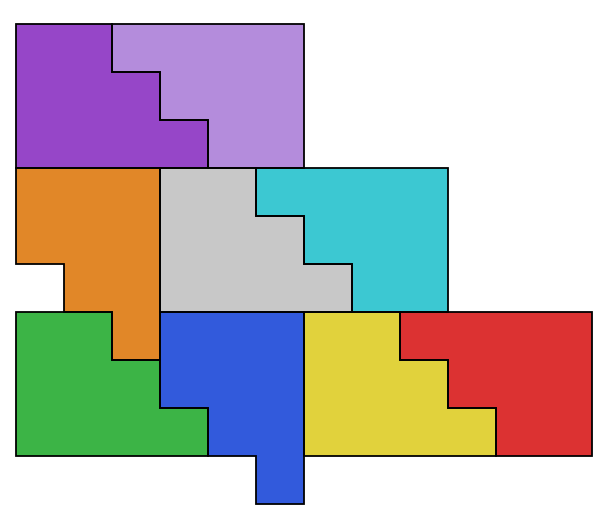
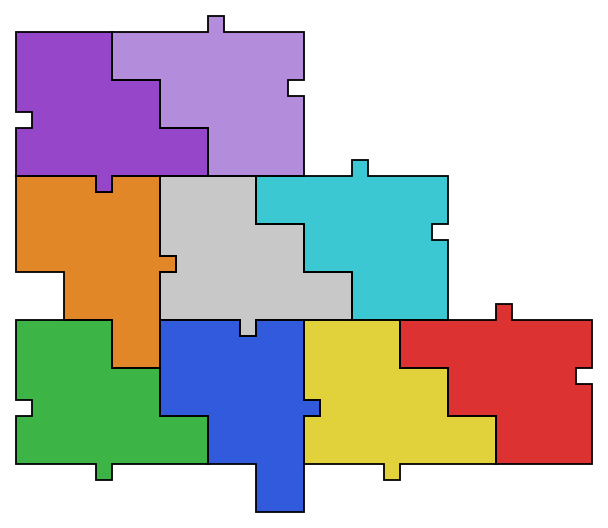
Why the boundary dimension is so high. The recursion is a universal identity — it says nothing about the shape of the attractor. What matters is how the silhouette of compares to (the would-be rep-tile). If they agreed exactly, the HD Tile would be a polyomino rep-tile with a polygonal boundary (dim = 1). They don’t — and the precise quantity that controls this disagreement is the spectral radius of the boundary substitution: the linear recursion that tracks the number of boundary cells of .
For any self-similar polyomino IFS with scaling 3 and nine digits, lies in the half-open interval : corresponds to a true rep-tile with , and is the degenerate limit where the tile loses its interior. Whenever is a genuine tile (non-empty interior, OSC), the boundary has Lebesgue measure zero, so strictly. The dimension of the boundary is
Holes emerge. Starting at the polyominoes are no longer simply connected: the first 18 holes appear inside , and their number grows rapidly ( has 216 holes, has 2 086). At the same stage sub-pieces begin to overlap (16 coincidences at , 330 at ), so drops below . The polyomino model is thus a faithful picture of the limit tile only for .
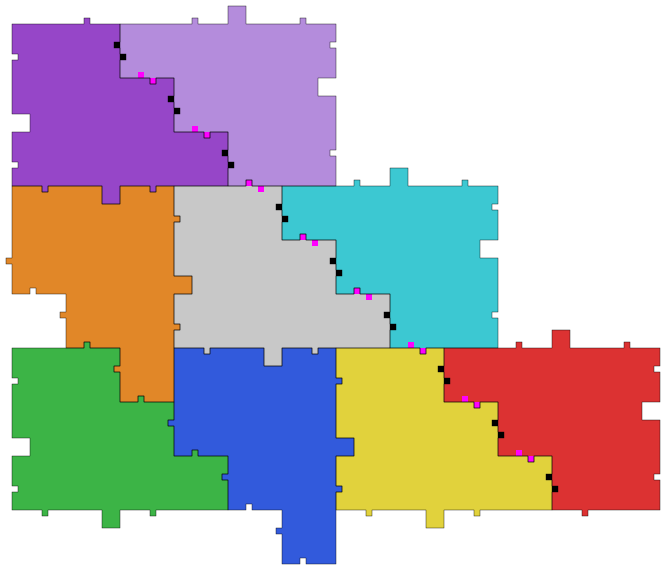
Late collisions drive to the ceiling. Each collision between two sub-pieces and — a shared cell or a trapped hole — removes a pair of boundary edges that would otherwise survive into . While no collisions occur, the boundary grows by the full factor per step, and the boundary substitution acts indistinguishably from the full area substitution: nearly every pair of adjacent cells along the current boundary remains adjacent in the next generation, and new boundary pairs appear wherever they possibly can. The spectral radius of the boundary substitution is therefore pushed toward its ceiling of by every generation in which collisions are absent, and the mismatch between and gets spread along the whole boundary rather than concentrated in a thin collar. For the HD Tile, no collision happens at — three full generations of loss-free boundary growth — before the first 18 holes and 16 overlaps appear at . That unusually long delay is the geometric reason sits so close to the theoretical maximum, and hence why — a fractal curve that almost, but not quite, fills the plane.
The neighbor graph confirms the OSC and yields the 13 pairwise boundary pieces . Piece is a single-point contact (dim = 0); the remaining 12 pieces all have dimension governed by the same degree-7 polynomial as above, giving the final value .
Zoomed Interior Detail
With the boundary is so rough that it is not obvious from the full-tile picture whether has interior at all. The following canvas is zoomed ≈ 716× into the tile (viewport radius vs bounding radius ), centered at approximately . A large, roughly square solid yellow region — a piece of pure interior of — fills the middle of the view, surrounded by the near-planar fractal texture of at the edges of the frame. This is a direct visual confirmation that , the conclusion already guaranteed by the tiling criterion above but here made concrete.